Equipment and furniture · 6 min read
Fume Cupboards for Schools: Ducted vs Ductless
How ducted and ductless fume cupboards work, which suits a school lab, the standards to check, and what each needs for installation and upkeep.
By Charleston Education Team · Published · Read this guide in Thai
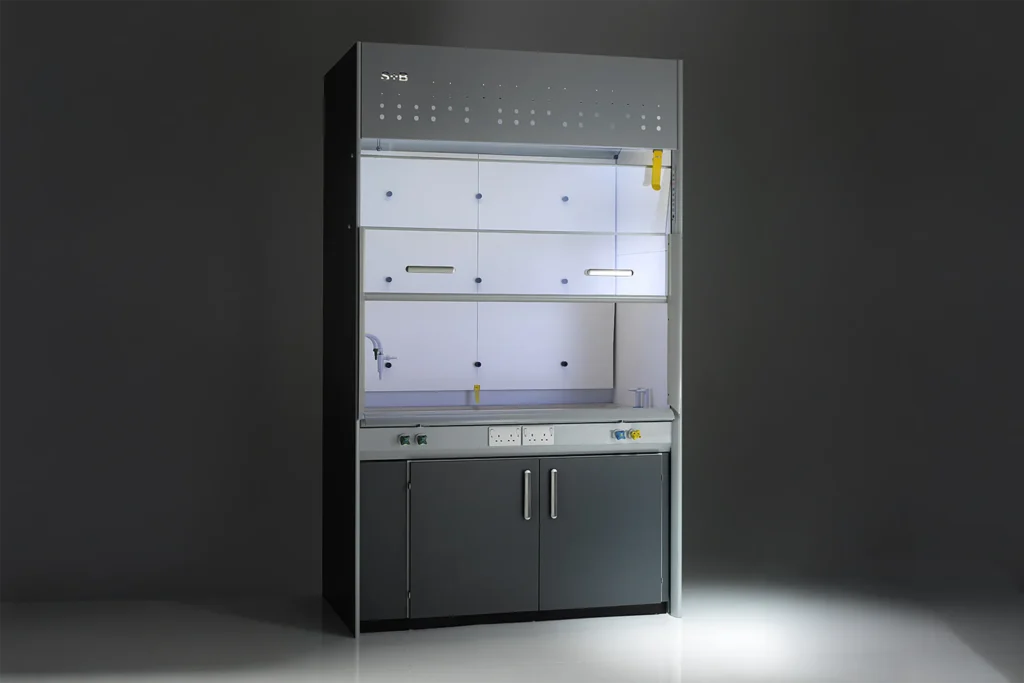
A ducted fume cupboard pulls air out of the cupboard and sends it outside through ductwork and a fan. A ductless (recirculating or filtration) fume cupboard draws air through filters and returns it to the room. For most secondary school chemistry, ducted is the more versatile choice: it handles a broad range of chemicals and does not depend on matching a filter to each one. Ductless units suit labs where no duct route is possible, or where the chemicals used are few, known and controlled.
Why schools need fume cupboards
Some school practicals give off gases or vapours that students and staff should not breathe: work with concentrated acids, some organic chemistry, and reactions that release chlorine or other irritant gases. General room ventilation will not deal with these. A fume cupboard captures the fumes where they are produced and keeps them away from the person working.
CLEAPSS publishes guidance on fume cupboards in schools (its guide G9). Your risk assessment for each practical should say when a fume cupboard is needed.
How each type works
Ducted fume cupboards
- A fan, usually on the roof or at the end of the duct run, pulls air in through the front of the cupboard.
- Ductwork carries the fumes outside and discharges them away from windows and air intakes.
- The cupboard does not clean the air; it moves it out of the building.
- BS EN 14175 covers performance and testing.
Ductless (recirculating filtration) fume cupboards
- A fan in the unit pulls air through one or more filters, often activated carbon, sometimes with a particle filter as well.
- The filtered air goes back into the room.
- The filters have to suit the chemicals in use, and they saturate over time.
- BS EN 14175 sets the general fume cupboard requirements. Recirculating filtration units are also commonly assessed against standards such as BS 7989 or the French AFNOR NF X15-211, so ask the supplier which standard the unit was tested to.
Side-by-side comparison
| Factor | Ducted | Ductless |
|---|---|---|
| How fumes are handled | Removed from the building | Filtered and returned to the room |
| Range of chemicals | Broad | Limited to what the filters are rated for |
| Installation | Needs a duct route, fan and roof or wall penetration | No external duct; needs power and space |
| Upfront cost | Higher where ductwork is long or complex | Often lower to install |
| Running cost | Fan energy, plus energy to replace conditioned room air | Filter replacement every [X] months, plus fan energy |
| Maintenance | Annual testing, fan and duct inspection | Filter monitoring and replacement, annual testing |
| Moving later | Difficult, duct must be re-routed | Easier, units can be relocated |
| Best suited to | Secondary chemistry, A level and IB practicals | Rooms with no duct route, limited and known chemical use |
Things that often get missed
Air conditioning and make-up air
Most labs in Thailand are air conditioned. A ducted fume cupboard pulls conditioned air out of the room, and that air has to be replaced. If the room's air supply was not designed for it, the cupboard may not extract properly, doors can become hard to open, and the air conditioning works harder. Ask your mechanical engineer to check the room air balance as part of the design.
Ductless units return the air to the room, so they do not create this demand. That is one reason schools sometimes choose them for air-conditioned rooms with no easy duct route.
Filter management
The main risk with a ductless unit is a filter that is full or wrong for the job. If it is not rated for the chemical, or is saturated, fumes pass straight back into the room. Before choosing ductless, ask:
- Which chemicals will be used in the cupboard, and in what quantities?
- Has the supplier confirmed the filter is suitable for each one?
- Does the unit have a filter saturation alarm?
- Who checks and logs filter condition, and how often?
- What does a replacement filter cost, and is it in the quote?
If your science department cannot keep a reliable list of the chemicals used in the cupboard, choose ducted.
Duct routes
With a ducted unit, the duct route can decide where the cupboard goes. Upper floors, roof access, and nearby windows or air intakes all limit where the discharge can go. Check the route during the audit, before the layout is fixed.
Position in the room
Wherever it sits, a fume cupboard should be:
- Away from doors and busy walkways, where people walking past can disturb the airflow.
- Away from air conditioning outlets that blow across the front of the sash.
- Visible from the teacher's position.
- Accessible for a wheelchair user, if your accessibility plan requires it.
Mobile and demonstration fume cupboards
Some schools use a mobile ductless fume cupboard on castors that moves between labs, or a two-sided demonstration unit that students can watch from both sides. Both work well for teacher demonstrations. Check the filter rating and how stable the unit is, and make sure it is plugged in and running before use.
Testing and maintenance
Whichever type you choose, plan for:
- A commissioning test at installation, against BS EN 14175 (and the relevant filtration standard for ductless units).
- Routine testing, commonly at least once a year. Check current CLEAPSS guidance for the recommended frequency.
- An airflow indicator on the cupboard, so users can see it is working.
- A logbook of tests, filter changes and faults.
Put testing and filters in the running-cost budget alongside the purchase.
Questions to ask a fume cupboard supplier
Check that each quote covers the same things before you compare them:
- Which standard has the unit been tested to, and can you see the test report?
- Is installation of ductwork, fans and roof or wall penetrations included in the price?
- For ductless units, which filters are fitted, and which chemicals are they rated for?
- Is commissioning testing included, and who carries it out?
- What is the warranty, and who provides service and filters in Thailand?
- What lead time applies if the unit is imported?
Two quotes with similar totals can cover very different scope, so ask each supplier to list exactly what is included.
Which should your school choose?
- What chemistry is taught? A broad A level or IB chemistry programme usually points to ducted.
- Is there a practical duct route? If not, ductless may be the only workable option.
- Can you manage filters? If regular filter checks and records are not realistic, avoid ductless.
- Is the room air conditioned? If you choose ducted, the mechanical design must provide replacement air.
- Will the cupboard need to move? Ductless is easier to relocate.
- What is the whole-life cost? Compare purchase, installation, energy, filters and testing over [X] years.
Quick guide
| Situation | Usual recommendation |
|---|---|
| Secondary chemistry lab, duct route available | Ducted |
| Prep room for a busy science department | Ducted |
| Primary or lower secondary room, limited demonstrations | Ductless may be suitable |
| Upper floor lab with no route to outside | Ductless, with careful chemical control |
| Shared demonstration across several labs | Mobile ductless unit |
These are general patterns. Your risk assessments and your designer's advice should settle the final choice.
Get the right fume cupboard for your lab
We supply and install fume cupboards from SB Labs and BFX as part of complete lab projects, and the rest of the lab can come from the same ranges or from our own value range, matched to your budget. If you are not sure which type suits your rooms, a free Facilities Audit includes a check of duct routes, room ventilation and your current cupboards. See our science lab design and build service, or read School Science Lab Design Standards for the wider picture.
Related service: Science Labs
About the author: Charleston Education Team
The Charleston Education team designs, supplies and installs science labs and learning spaces for international schools across Thailand, working with SB Labs (UK), BFX (Australia) and our own furniture range.